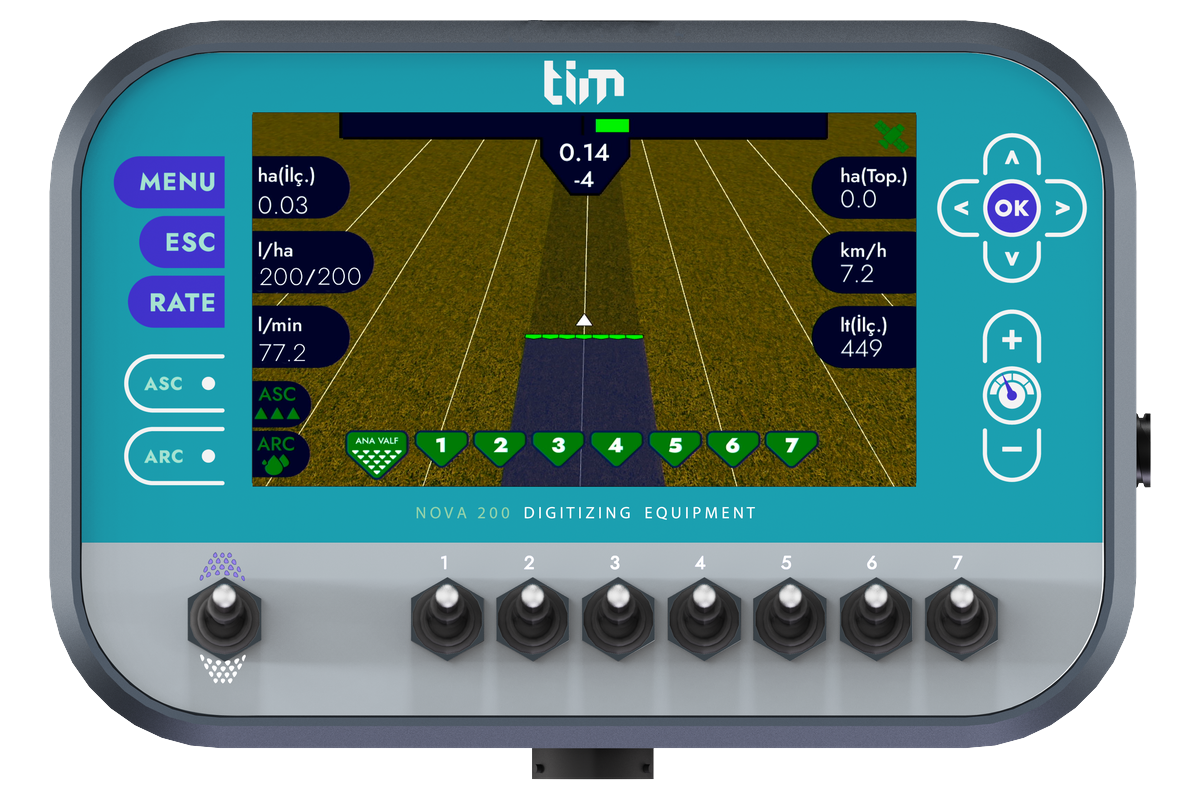
If you've spent a season behind a sprayer, you already know the moment: you're approaching a headland, the boom hangs over a strip you've already covered, and the operator has to decide — left section off, right section on, all sections cut? By the time the decision is made, two meters of double-spray have hit the soil.
Multiply that by every turn, every irregular corner, every wedge-shaped sub-field, and you start to understand why the industry baseline for chemical waste from overlap is 15–25%. On a 1,200 hectare grain farm, that's not a rounding error. It's a meaningful line on the cost sheet.
What Auto Section Control actually does
Auto Section Control (ASC) is the answer to that decision moment. The controller reads two pieces of information continuously:
- GNSS position — where the boom is, accurate to under 2 cm with RTK.
- Field coverage map — which areas have already been sprayed.
When a boom section enters an already-covered area, ASC closes that specific section. When it crosses a field boundary, it shuts off. When the operator turns around, sections re-open in the precise sequence needed to avoid both overlap and skips.
It's not magic — it's geometry and timing. But the result is consistent enough that field tests across irregular wheat and corn fields show 25–35% reduction in chemical waste versus manual operation.
Why headlands cost more than you think
Most farmers know about overlap. Fewer realize that the headland zone — the turning area at the end of each pass — is where the highest concentration of waste happens.
A typical 24-meter boom turning on a 100-meter pass length will:
- Spray the headland strip when entering the field
- Cover it again when finishing each pass
- Often pass it a third time when leaving
Without section control, the operator can only switch the entire boom on or off. With ASC, only the sections that are over uncovered ground stay open. The savings on headlands alone often justify the investment.
How the math actually works
For a 1,200 ha grain farm spraying twice a season with a $80/ha chemical cost:
Annual chemical spend (manual):  1,200 × 2 × $80 = $192,000
Industry waste rate (manual):                            18%
Wasted chemical:                                  $34,560

Annual spend with ASC:           1,200 × 2 × $80 = $192,000
ASC waste reduction:                                     85%
Wasted chemical with ASC:         $34,560 × 15%  =  $5,184

Annual savings:                                   $29,376
This is the conservative case. Farms with highly irregular field boundaries see larger savings.
What's required to make ASC work
ASC isn't a feature you bolt on top of any setup. It requires:
- Section valves that can be individually controlled by the rate controller
- GNSS receiver with at least sub-meter accuracy (RTK preferred)
- Boom width and section configuration correctly profiled in the controller
- Calibrated nozzles with known flow characteristics
When all four pieces line up, ASC runs in the background while the operator focuses on driving.
Where Tim Nova 200 fits
Nova 200 ships with ASC as a core feature, paired with RTK-grade GNSS through the Cross 300 base station. The boom configuration — width, section count, nozzle spacing — is stored as a tractor/sprayer profile, so operators switching between machines don't reconfigure from scratch.
The Field Boundary feature complements ASC: once you've driven the perimeter of a field, the controller remembers it. The next time you spray, the sections automatically close at the boundary line, not where you remember it being.
For farms running 500+ hectares, the payback period for the Nova 200 + RTK GNSS package typically lands between 12 and 18 months. After that, every season's savings drops to the bottom line.
What to measure before you upgrade
If you're considering ASC, document these three numbers for a typical spray operation:
- Total chemical used (liters or kilograms)
- Total area covered (hectares)
- Effective coverage — area times applied rate divided by total chemical used
If your effective coverage is 75–85% of nominal, you're losing about 15–25% to overlap. That's your real savings ceiling with ASC.
Want to see how this works on your equipment? Book a 20-minute live demo with our agronomy team — we'll walk through ASC, field boundary recording, and how it integrates with your existing sprayer.