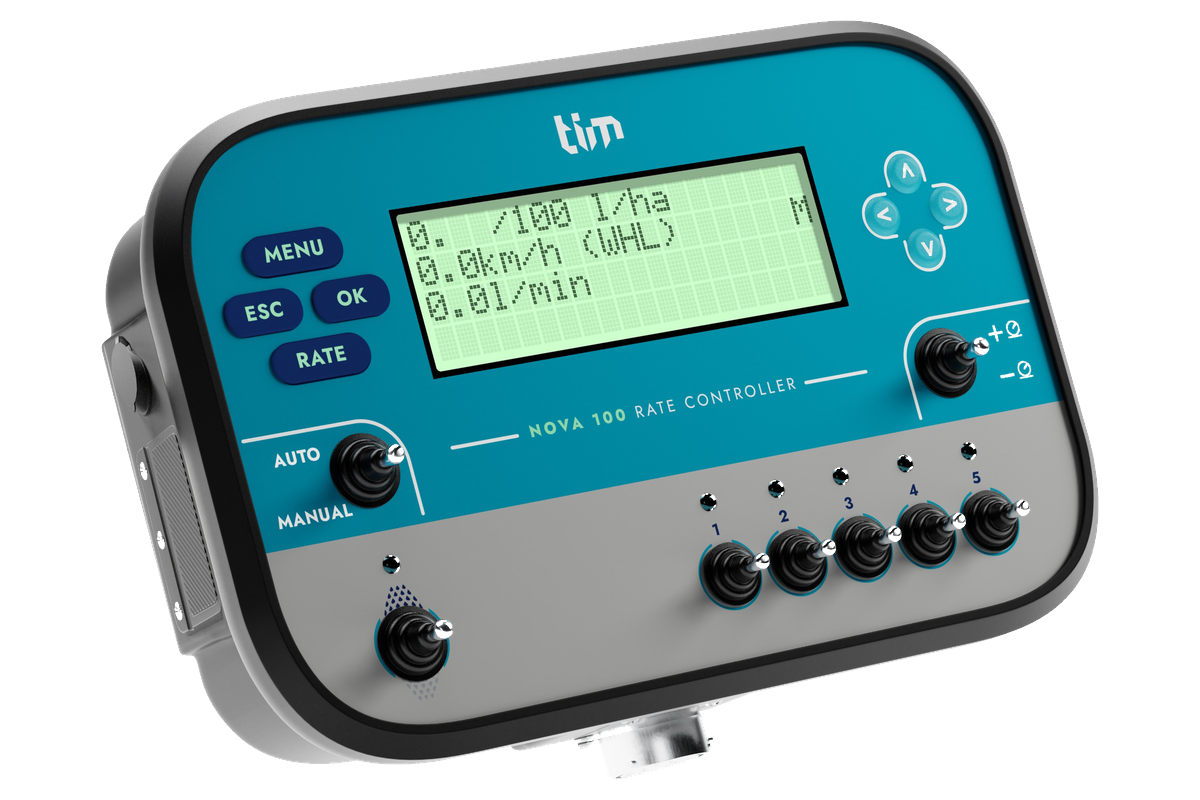
You can have the best rate controller on the market and still spray badly if your nozzles are wrong for the job. The nozzle determines droplet size, distribution pattern, drift behavior — basically everything that happens between your tank and your crop.
The good news: nozzle selection is one of the few areas of precision agriculture where the rules are well-established and stable. The bad news: most operators inherit nozzle choices from the previous operator and never revisit them.
This is a practical guide to picking the right nozzle for what you're actually doing.
The three nozzle families you'll encounter
Flat fan (yelpaze)
The default for broadcast field spraying. Produces a flat, even spray pattern across the boom. Different angles (80°, 110°, 120°) give different boom heights.
- Best for: Pre-emergent herbicides, fungicides, foliar fertilizer
- Pressure range: 1.5–4 bar
- Droplet size: Medium (varies with pressure)
Hollow cone (konik)
Produces a ring-shaped spray pattern. Better penetration through dense canopies.
- Best for: Orchards, vineyards, dense crops where leaves block flat-fan coverage
- Pressure range: 3–10 bar
- Droplet size: Fine (drifts more)
Air-induction (havadan destekli)
Mixes air into the spray, producing larger droplets that resist drift.
- Best for: Drift-sensitive applications, windy conditions, near neighboring crops
- Pressure range: 2–6 bar
- Droplet size: Coarse to very coarse
The pressure–flow relationship
Every nozzle has a published flow rate at a reference pressure (usually 3 bar). Flow doesn't scale linearly with pressure — it follows the square root of the pressure ratio:
New flow = Reference flow × √(New pressure / Reference pressure)
A practical example: if a nozzle delivers 1.0 L/min at 3 bar, at 5 bar it'll deliver:
1.0 × √(5/3) = 1.0 × 1.29 = 1.29 L/min
That's only a 29% increase in flow for a 67% increase in pressure. Doubling pressure does not double flow.
This matters because if your rate controller compensates for speed by increasing pressure, you have a narrow operating window. Push pressure too high and droplets get small enough to drift; too low and the spray pattern collapses.
How to size your nozzle for the job
Three things determine the required flow per nozzle:
- Target application rate (L/ha)
- Sprayer ground speed (km/h)
- Nozzle spacing (m)
The formula:
Flow per nozzle (L/min) = (L/ha × km/h × nozzle spacing in meters) / 600
A worked example: 200 L/ha rate, 8 km/h ground speed, 50 cm nozzle spacing:
(200 × 8 × 0.5) / 600 = 1.33 L/min per nozzle
You'd select a nozzle that delivers 1.33 L/min near the middle of its pressure range. For most flat-fan nozzles, that's around 2.5–3 bar.
Don't pick a nozzle that hits 1.33 L/min only at maximum pressure — you'll have no headroom for speed variations.
Quick guide: matching nozzle to application
| Application | Recommended nozzle | Pressure | Why |
|---|---|---|---|
| Pre-emergent herbicide | Flat fan, anti-drift | 2–3 bar | Even ground coverage, low drift |
| Post-emergent herbicide | Flat fan or air-induction | 2.5–4 bar | Foliar contact, manageable drift |
| Fungicide on cereals | Flat fan, fine droplet | 3–4 bar | Penetration into canopy |
| Insecticide | Flat fan or hollow cone | 3–5 bar | Coverage on both leaf surfaces |
| Orchard spraying | Hollow cone with air-blast | 5–8 bar | Penetrates dense foliage |
| Near sensitive crops | Air-induction | 2–4 bar | Drift reduction is priority |
Calibration in 4 steps
Whatever nozzle you pick, calibrate before the season starts:
- Fill with clean water and run the sprayer at target pressure
- Catch output from 3–5 nozzles at different positions for 60 seconds each
- Compare measured volume to manufacturer's chart
- Replace any nozzle delivering >10% off the average — they're worn
A worn nozzle is the silent killer of application accuracy. Most operators don't realize nozzles wear out — they do, especially when spraying abrasive products like fertilizer solutions. Plan to replace nozzles every 2–3 seasons of heavy use.
Where Tim fits
Tim Nova 100 and Nova 200 controllers handle the rate-pressure-speed math for you in real time. The Nova 110 adds fan control for airblast sprayers in orchards.
But: the controller is only as good as the nozzles you give it. Pick the right type, replace them on schedule, and verify with a calibration check before each major spraying window.
Want to skip the formulas? Use our Nozzle Calculator — enter your speed, boom width, spacing and target rate, and you get the required flow per nozzle instantly.