The biggest mistake farms make moving to precision agriculture isn't picking the wrong controller. It's trying to do everything at once.
We've watched operations buy a flagship system with Auto Section Control, RTK GNSS, VRA prescription maps, and a tablet for the operator — only to roll it back six months later because nobody knew which feature was actually saving money and which was creating new problems.
This article is for farms that haven't started yet, or that started and stalled. It's a realistic four-phase roadmap.
Phase 1: Measure what you have
Before you buy anything, document where you are. You need three numbers:
- Total chemical/fertilizer used in a typical season (in liters or kilograms)
- Total hectares covered in those operations
- Effective coverage rate — your applied amount divided by your nominal target
If your nominal rate is 200 L/ha and you're using 240 L/ha on average, you have a 20% overlap waste rate. That's your improvement ceiling.
Skip this phase and you'll never know if the new system actually helped.
Phase 2: Add rate control (not GNSS)
The single highest-ROI upgrade for most farms isn't GPS — it's a rate controller.
A basic rate controller does one thing well: it keeps your application rate constant regardless of tractor speed. Slow down for a wet patch, speed up on a clear stretch — the controller adjusts pressure to maintain the same liters per hectare.
Without it, your effective rate swings wildly across the field. With it, you spray at the rate you intended.
Typical results in Phase 2:
- 8–15% chemical savings from consistent application
- 1–3 weeks to train operators (they still drive normally)
- Payback period: 8–12 months for most farms
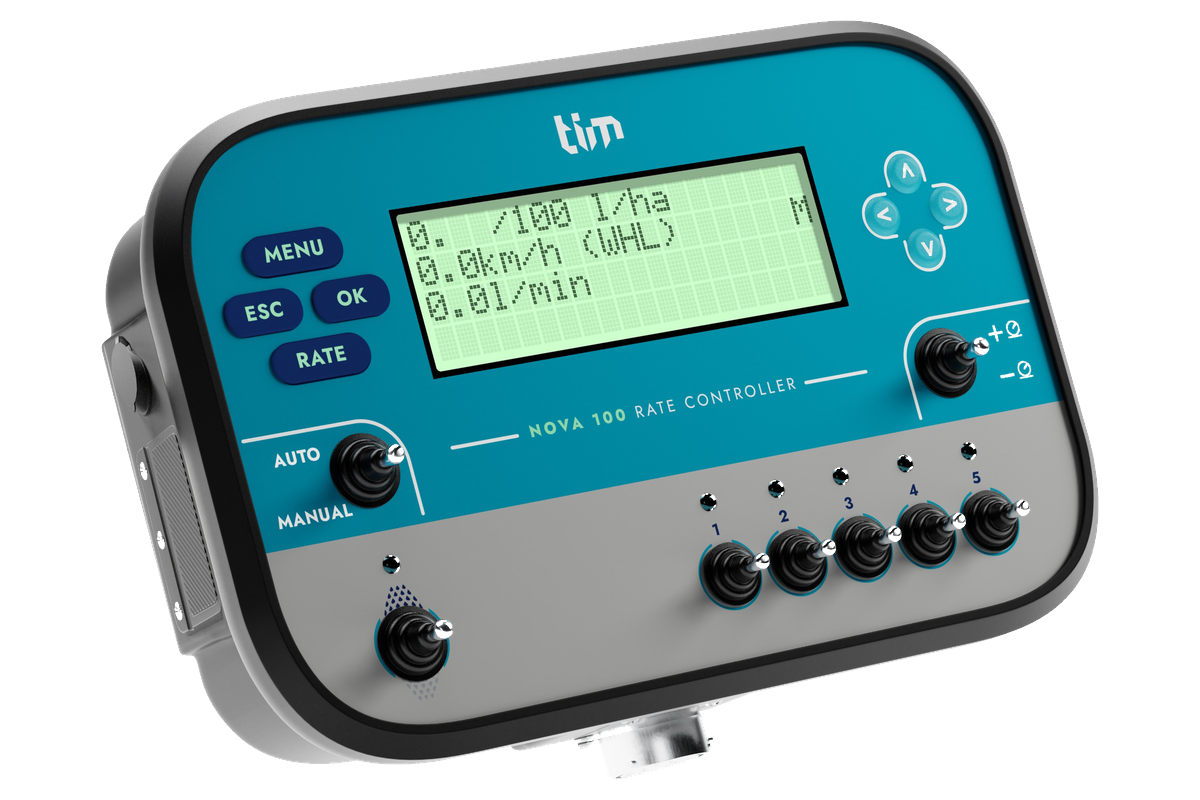
Equipment fit: Nova 100 (or Nova 110 for orchards) does this. No GPS needed for Phase 2.
Phase 3: Add basic GNSS
Once Phase 2 is working and the savings are visible, add GNSS guidance.
At this stage you're not buying RTK or auto-section yet. You're buying simple position awareness — the operator sees a line on the screen showing where they've already sprayed, and steers manually to avoid double-coverage.
Typical results in Phase 3:
- Additional 5–10% chemical savings from operator awareness
- 1 week training (operators need to learn to read the display)
- Payback on the GNSS upgrade alone: 12–18 months
Equipment fit: Add a basic GNSS like Cross 100 to your existing Nova 100/110.
Phase 4: Auto Section Control + RTK
Now you're ready for the full precision package. Phase 4 adds:
- Automatic boom section control based on coverage map
- RTK-grade GNSS for 2 cm accuracy
- Field boundary recording to stop spraying outside the field
- Pause/resume points for refills mid-field
Typical results in Phase 4:
- Additional 15–20% chemical savings on top of Phase 2+3
- 2–4 weeks training (operators need to trust the automation)
- Payback period: 12–18 months for medium-to-large farms
Equipment fit: Nova 200 with Cross 300 RTK. This is also the point where TimApp becomes useful — managing multiple operators, jobs, and reporting.
What about jumping straight to Phase 4?
You can. For very large farms (>2,000 ha) or contract sprayers, going directly to Phase 4 often makes sense — the absolute savings are large enough to justify the steeper learning curve.
But for farms under 1,000 ha or for operations with mixed-skill operators, phased adoption almost always outperforms a single-step transition. You learn what works, you train people incrementally, and each phase validates the next investment.
The training pattern that works
For every phase, follow this rhythm:
Week 1: Install hardware. Operators watch a 30-minute walkthrough, then run dry-cycles in the yard.
Week 2: First field operation with a trainer present. Run with operators making mistakes — that's the point. The trainer corrects in real time.
Week 3–4: Operators run solo. Daily check-in on what's working and what's confusing.
Month 2: Review the season's data with the operators. Show them the chemical savings or the missed-coverage events. People who see their own data adopt faster.
What goes wrong (and how to avoid it)
Three patterns kill precision agriculture rollouts:
-
The "set and forget" operator. Some operators set a target rate once and never look at the display again. Counter-measure: insist on a daily 60-second post-job review. Coverage map, total area, average rate.
-
The "I know better" operator. Experienced operators sometimes override the auto controls because their gut tells them otherwise. Counter-measure: pull the data after the season. Compare overridden jobs to auto jobs side-by-side.
-
The "broken sensor" excuse. When something goes wrong, operators blame the system. Sometimes they're right. Often the issue is calibration or a worn nozzle. Counter-measure: a 20-minute pre-season calibration ritual that everyone runs.
Where Tim's product line fits the phases
We designed the Tim portfolio explicitly for phased adoption:
- Phase 2: Nova 100 (field) or Nova 110 (orchard) handle rate control alone
- Phase 3: Add Cross 100 GNSS — same Nova controller, more capability
- Phase 4: Nova 200 + Cross 300 RTK — full precision package
Operators trained on Nova 100 can move to Nova 200 in days, not weeks. The UI follows the same conventions across the line. That continuity matters more than any single feature.
Wherever you are in the transition, we can help you plan the next step. Tell us what you have and what you're spraying, and we'll show you a phased path with real numbers — not vendor pitch numbers.